
TACOM
Forging the Future of Ground Power

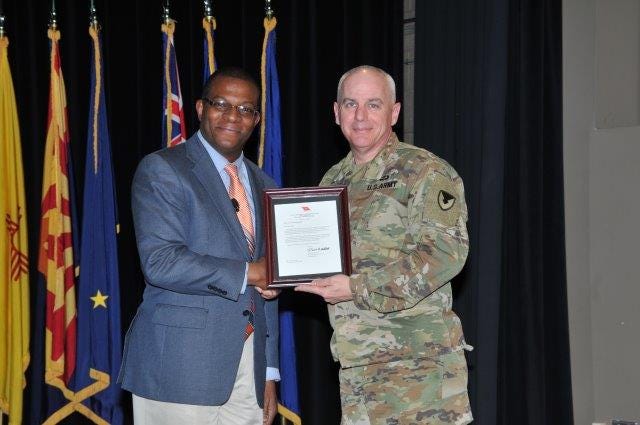
In 2019 I did a speech at TACOM (U.S. Army Tank-Automotive & Armaments Command) provided a valuable opportunity to connect with the military and civilian workers that keep our ground forces moving forward. Almost every major ground vehicle the U.S. Army uses to project power, in some way, shape or form, is built, repaired, tested, or has its next-generation design envisioned here. This long and storied command, operating always with the future in mind, has impacted and influenced the modern battlefield for pretty much the last 50 years.
We saw this transition clearly with the Cold War era. In the 1970s, the M-60 Patton Tank was a symbol of strength with its tough appearance and high silhouette. By the 1980s, TACOM ushered in the new, streamlined, low-silhouette M1A1 Abrams, carrying cutting-edge armor and targeting systems. It was initially designed to fire a 105mm tube, later upgraded to the current 120mm cannon, capable of sending an APFSDS (Armor Piercing Fin Stabilized Discarding Sabot) round down range 1.5 miles while the tank moves at 50 mph.
The armor was classified and high-tech, the combat system was classified and high-tech, and the ground system worked effectively across multiple major conflicts: from Gulf War One (1990–1991) to Gulf War Two (2003–2011), and throughout the GWOT (Global War on Terror) from 2001 to 2022, all the way to the current operations in the Russia-Ukraine War (where M-1s were introduced in 2023).
TACOM is a premiere command—without a doubt.